Decomposing Epics Into Agent-Ready Sub-Issues
Set boundaries before work starts so agents execute toward clear, verifiable outcomes.
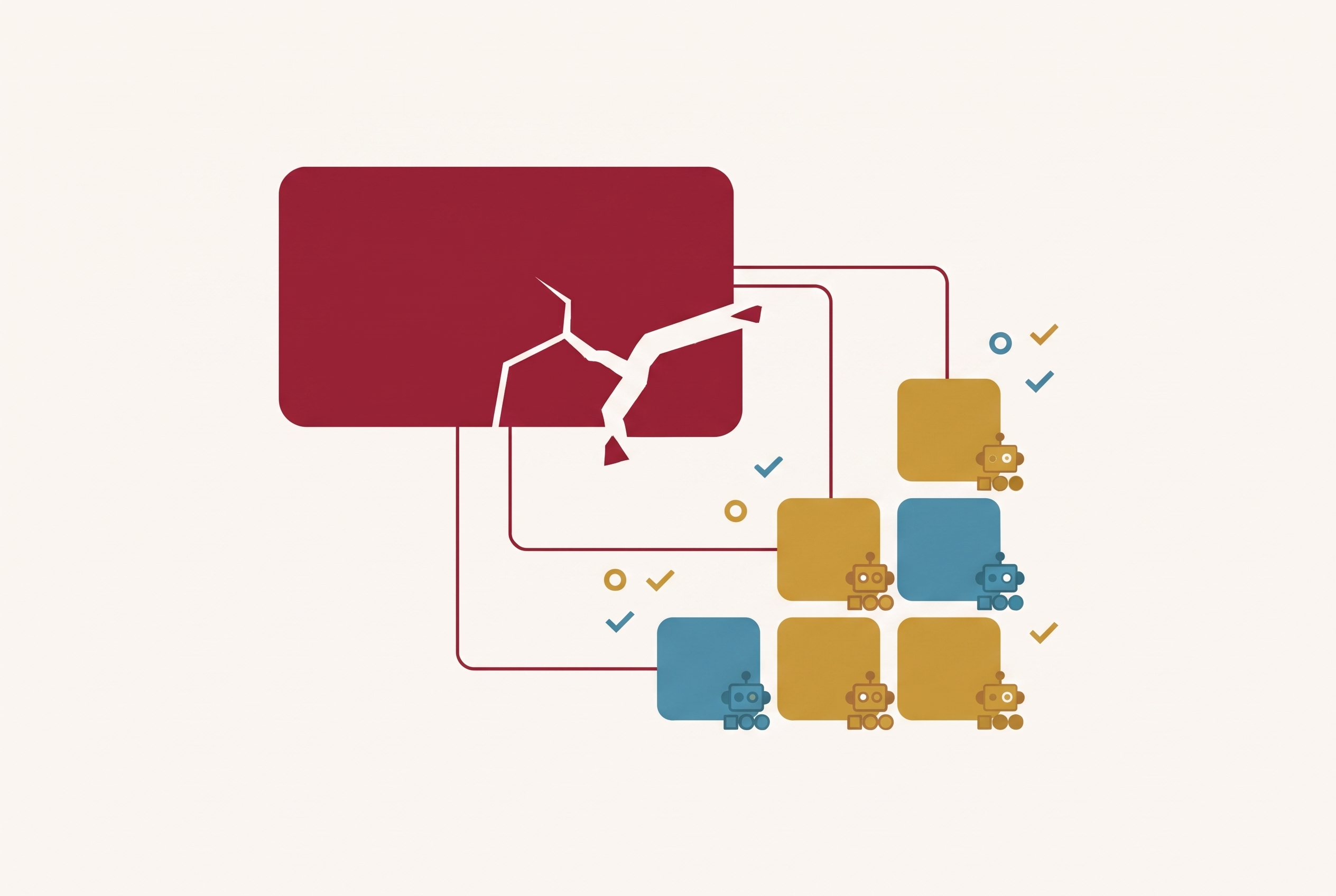
Decomposing epics into agent-ready sub-issues requires a different standard from writing traditional user stories. When agents can do implementation work reliably, a project's success depends more on the boundaries set before the work starts. Each sub-issue needs bounded scope, explicit inputs and outputs, and acceptance criteria the agent can verify without redefining success.
Why the quality of epic decomposition now determines project outcomes
The delivery rhythm is shifting from a developer writing a patch to an agent executing a patch-shaped problem. Previously, the central question was whether a developer could implement a change correctly and quickly. With reliable agent execution, the harder question moves upstream. Can the team define the change precisely enough to leave little room for mistaken interpretation?
That shift changes the value of planning work. Decomposition determines what the agent attempts, which constraints govern its choices, and when it stops. A flaw in any of those decisions can remain even when the implementation is otherwise sound. Planning and decomposition become technical work with a large effect on the result, and belong within the engineering work.
What an epic actually is and why its structure sets the ceiling for everything below it
An epic is a strategic container for work spanning multiple sprints and breaking into multiple stories. Its purpose is to hold an intended outcome while leaving room for conversations about how to achieve it. That incompleteness is appropriate early on, but it becomes a liability when teams split the epic before resolving its central questions.
The hierarchy from epic to story to sub-task limits what careful ticket writing can accomplish. A story can describe an implementation precisely while inheriting the wrong objective. Common sources of that mismatch include organizing scope by technical layers instead of user journeys or business value, omitting measurable success criteria, and leaving exclusions unstated. Each makes the boundary harder to draw.
Splitting by user journey, business rule, data type, or user role provides a stronger basis for decomposition because each can produce a bounded, describable outcome. The split then preserves a reason for the work. This gives reviewers a basis for judging whether the resulting stories belong in the epic at all.
How AI-assisted decomposition creates a false-confidence trap before agent work even begins
Mountain Goat Software describes a meeting in which a product owner presented 500 backlog items for a new product and asked the team to identify omissions. No one could tell what was missing. The detail obscured the product as a whole, making the review harder. AI-assisted decomposition makes this failure easier to repeat because it can produce a backlog that looks polished and fits together in minutes.
AI can confidently generate table-stakes capabilities while overlooking what the Kano model calls delighters, the differentiating capabilities users do not explicitly request. Without evidence from user interviews, the output lists needs that seem likely but have yet to be shown. If those items pass directly to agents, clean execution can produce the wrong product.
The company recommends starting with a small set of human-identified epics that lets reviewers see the product whole, then asking AI to decompose one or two at a time. This preserves a reviewable level of abstraction before volume makes omissions difficult to detect.
What strategic context must exist at the epic level before decomposition produces usable sub-issues
A human-reviewed epic gives decomposition a product-level test. It must state the outcome the product should create and who will use it. It must also explain how those users work today, what is slow or frustrating about that approach, and what would motivate adoption. These are inputs to the split.
The epic also needs a measure of success, constraints, and explicit non-goals. Together, those details function as acceptance criteria for the epic itself. A proposed story can then be assessed against the intended outcome. AI-assisted review has a clearer basis for distinguishing a generic feature from one that serves the intended positioning.
Human review at this level can expose missing user types, absent workflows, and features included merely because competitors have them. Individual stories rarely show enough of the product to make those judgments. The sequence therefore starts with review of the high-level epics, continues with AI-assisted decomposition of the highest-priority ones, and ends with human review of the resulting stories. It does not collapse into a single generation pass.
Why a well-written user story is still not an agent-ready sub-issue
A human receiving an ambiguous story can ask a colleague what it means. An agent executing a ticket without that clarification path works from the context supplied and may fill gaps with plausible defaults. A well-written user story can still leave those gaps open.
The sub-issue must state what to build, express acceptance criteria as checkable “Done when” conditions, name the files or surfaces the change should touch, and make dependency state explicit. A human might work out scope during implementation, but the agent needs that scope settled before it starts. Open product or design questions and unresolved cross-stream dependencies do not belong in its execution queue.
Size is part of this contract. One sub-issue should fit a single agent session, roughly one pull request, so the agent can keep track of constraints without carrying them through a long series of problems. Schema or infrastructure changes that affect other streams must be settled outside that bounded assignment. The “one prompt, one issue” principle treats decomposition as performance tuning.
Acceptance criteria need to be as clear and exact as scope. “The user sees a confirmation message” leaves the stopping condition open to interpretation. “A 200 response is returned and the confirmation banner appears within 500ms” gives a machine something to evaluate.
Decomposition determines what the agent attempts, which constraints govern its choices, and when it stops.
How the agent failure modes that matter most trace back to decomposition decisions
One-shotting points first to a scope problem. When an agent attempts an entire feature in one session, it can exhaust its context window and leave the implementation half-built. Without a stopping condition, that oversized assignment is even harder to keep within bounds. The decomposition remedy is a smaller unit with a verifiable end state.
False completion indicates a different gap in the contract. The agent treats repository activity or partial progress as completion because the ticket describes intent and leaves the machine-checkable state undefined. Cascading errors show where validation is missing between steps, as later work builds on an incorrect tool call. Explicit intermediate states give checkpoint validation something concrete to test before the error propagates.
Context window decay also traces back to scope. Long sessions can lose early constraints as token budgets run down and recent information dominates. Parallel incompatibility shows where interface contracts are missing, as workers make choices that work on their own but do not fit together. These patterns provide a diagnostic map from failed execution to the decomposition decision that needs repair, rather than treating every failure as an undifferentiated model weakness.
How verification responsibility should be divided between humans and agents when acceptance criteria are set
Agent-written tests cannot independently validate agent-written code. Both can be wrong in the same direction, with the tests matching an implementation that fails to deliver the intended behavior. A passing result is therefore insufficient when the agent controls both the solution and its definition of success. Someone outside the implementation session needs to own the verification contract.
Humans should write or approve the acceptance tests that define behavior and protect them through code ownership rules. Those tests should not change in the pull request they validate. Under this division, agents own implementation within the contract, while humans own the acceptance tests, their protection, and the Definition of Ready gate. Self-verification means running an established test.
Ticket content also needs a security boundary. Sub-issues must be free of secrets, credentials, or personal data. The ticket itself is an attack surface because prompt injection can place instructions in its body that redirect agent behavior.
How readiness gates enforce decomposition standards before any agent session starts
A readiness gate gives teams a clear decision on whether work can go to an agent, replacing an informal judgment. The emerging pattern uses automated triage before any model call, without an LLM making the gate decision. Its purpose is to test required properties. This moves enforcement to the point where an unsuitable assignment can still be stopped cheaply.
A functional gate returns a verdict of ready, thin, or blocked, with a row for each check. Those checks cover acceptance criteria completeness, description length, done-state reachability, blockers, and scope. Teams can apply the same rule by hand by putting AI-generated stories in a draft status before they enter an active sprint.
Strictness must serve execution. Teams write differently, so the substantive checks are a verifiable stopping condition, explicit dependency state, and a scope cap. Mandatory gates become more useful as agent queues grow because overnight runs cannot stop for a human to judge every unclear ticket. ONES supports governed approval from requirements through delivery, giving teams a workflow in which they can apply the same readiness standards each time.
How multi-agent architectures change the decomposition unit without changing its requirements
An orchestrator that decomposes an epic and routes sub-issues to specialized workers moves the specification bottleneck one level higher. The epic becomes an input to automated planning. Any unresolved ambiguity can spread through the resulting assignments before a human catches it. As agents can do more of the work, teams need to be more specific before that work starts.
Parallel streams also make interface contracts non-optional at handoff points. Without them, the cost of integration can outweigh the gains from doing the work at the same time. Human coordination remains necessary even with five or more agents working in parallel, because planning prevents their assignments from colliding. Teams need skills in epic-level specification and interface-contract definition as well as prompt engineering for individual workers.
A working standard for sub-issues that teams can apply before the next sprint
If the outcome, target users, current-state pain, success metric, or non-goals are missing, the epic is not ready for decomposition. The next action is human review of that strategic context. Once it is sound, decomposition can proceed one or two epics at a time.
A sub-issue should enter the agent queue only when its implementation boundary is settled. What to build must be stated, the files or surfaces named, dependencies resolved or explicitly accounted for, and scope limited to one session. Its “Done when” conditions must be machine-evaluable, with no open design questions or schema changes left inside the assignment. Secrets must remain outside the ticket body.
Verification is a separate admission decision. The acceptance test must be human-authored or human-approved, machine-runnable, and protected against modification in the implementing pull request. A ticket with polished acceptance prose but no protected verification contract is not ready merely because it reads well.
ONES supports the chain through AI-assisted requirements development, backlog decomposition, acceptance criteria refinement, governed approval, and delivery tracking in one platform. Linking those steps helps teams enforce the same standards without leaving it to each person to follow them. The economic case is the cost of intervention. Upstream precision shifts work away from debugging failed sessions and reconciling incompatible outputs to an earlier checkpoint where correcting the assignment is cheaper than repairing its implementation.
Sources
- AI-Generated User Stories Need Human Judgment - Mountain Goat Software
Provided the anecdote about a product owner presenting 500 AI-generated backlog items and the recommendation to start with human-identified epics before AI decomposition.
- Agile epics: definition, examples, and templates
Informed the description of epics as strategic containers spanning multiple sprints that break into multiple stories.
- Epics, Features, and Stories: Agile Hierarchy Explained
Informed the explanation of the hierarchy from epic to story to sub-task and how that structure limits what careful ticket writing can accomplish.
- Updating the taxonomy of failure modes in agentic AI systems: What a year of red teaming taught us
Informed the discussion of agent failure modes including prompt injection as a security threat via ticket content.
- Characterizing Faults in Agentic AI: A Taxonomy of Types, Symptoms, and Root Causes
Informed the taxonomy of agent failure modes — one-shotting, false completion, cascading errors, and context window decay — traced back to decomposition decisions.